

Reducing friction while preserving human trust
This project demonstrates how thoughtful system design can reduce operational load while preserving trust in high-stakes, regulated workflows.
Context
Redacted runs an admissions-based program with a steady flow of prospective students. The existing registration and eligibility process relied on multiple tools, manual handoffs, and repeated data entry, creating operational strain for administrators and long wait times for students.

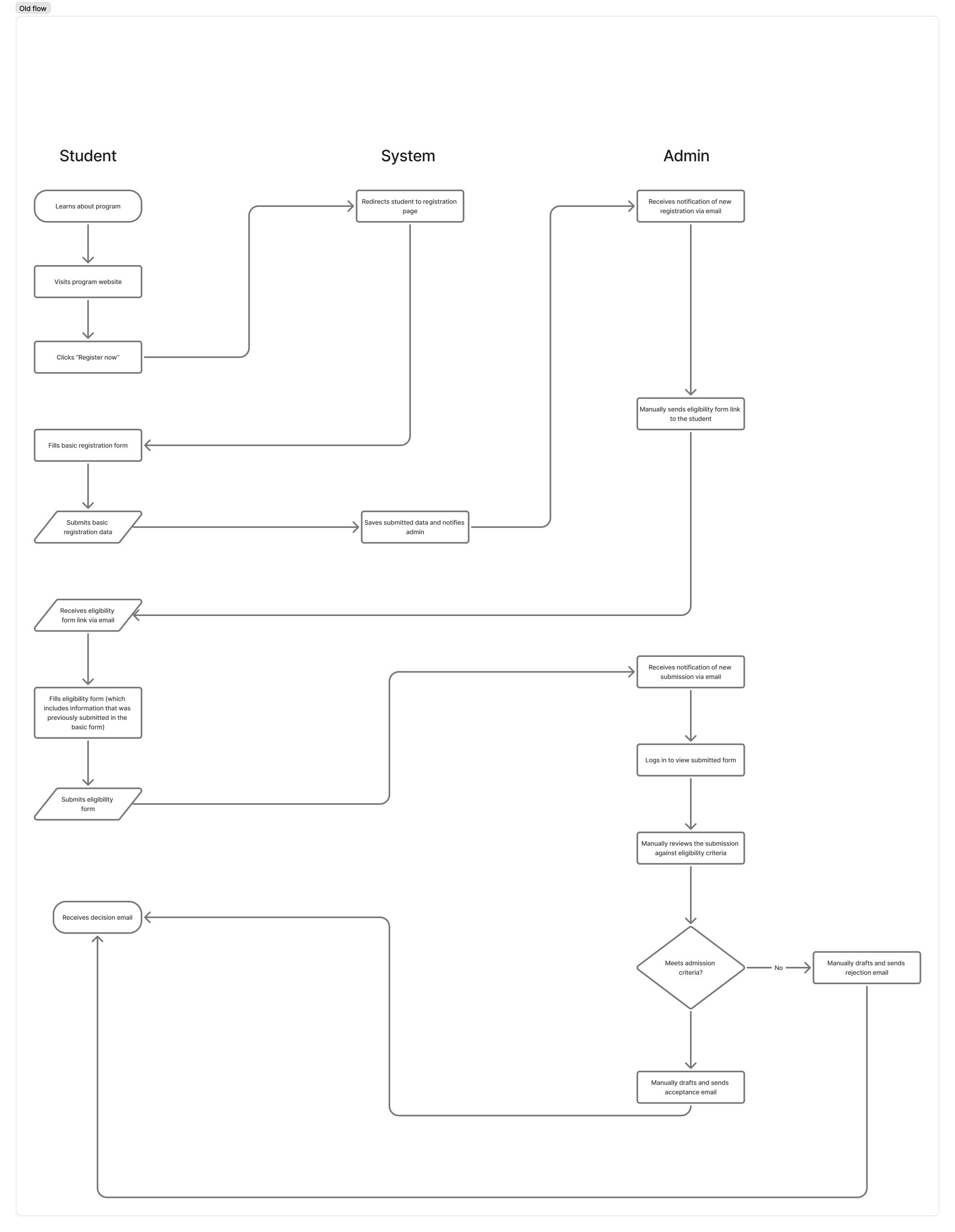
The Original Flow
Student visits the website and clicks “Register now”
They get redirected to a page with a basic form
Student fills out the basic form on the website (name, phone, email, address)
Admin receives a notification about the submitted form
Admin manually sends a Google form to the student (this information is used eventually to evaluate student’s eligibility for the program against admission criteria)
Student receives a link to the eligibility form via email
Student visits the link and fills out the eligibility form (including information that was already entered in the basic form)
Admin gets notified about the submitted eligibility form
Admin logs in and manually reviews submissions
Admin copies/pastes emails to notify students of acceptance or rejection
The problem with this flow:
Multiple steps across platforms: The process moves students and data across different tools, increasing errors, data loss, abandoned submissions, and risk of interception by malicious actors.
Long delays between submission and response: Students spend 45–60 minutes over multiple sessions to apply, and admin review can take weeks, creating large backlogs and frustration for both students and admins.
Scattered data across tools: Information is fragmented, making it hard to track, manage, or ensure consistency.
Tedious and time-consuming for admins: Hundreds of applications are received monthly, and these require a team of 10–15 people to process manually.
Repeated data entry: Students enter the same information multiple times in different forms, adding frustration and extra work for admins who have to sort through and make sense of everything.
Manual decision-making: Relying on humans for every step increases the likelihood of mistakes.
Project Goal
The primary objective of this project was to simplify the system end-to-end so as to reduce friction for both admins and students. The challenge was achieving this while preserving trust, data integrity, and maintaining fairness in key decision points.
MY ROLE
Identified critical issues in the old registration and eligibility evaluation flow
Analyzed the pain points for both students and admins
Designed and tested the new flow
Simplified eligibility criteria into structured if-else rules that preserve fairness while reducing manual work
Designed validation rules, error states, and email templates for both students and admins
Coordinated closely with engineering to implement technical constraints and run sandbox testing
Acted as the main client touchpoint, coordinating requirements, feedback, and approvals
Managed rollout planning, admin training, and operational safeguards
Balanced automation with human review for sensitive decisions to maintain trust
DESIGN GOALS
Reduce the number of steps and tools involved in the process
Eliminate repeated data entry
Shorten application and review time without sacrificing decision quality
Support admins in making fast, confident decisions with structured data
Use automation to remove friction, not to replace judgment
Preserve fairness, professionalism, and trust throughout the experience
Reduce operational risk and likelihood of human error
Create a system that scales without increasing admin workload
Improve clarity and confidence for both students and admins
CONSTRAINTS
Data collection must comply with Canadian privacy regulations
Sensitive information cannot be fully exposed via email
The system must scale without increasing admin workload
Automation must not feel impersonal or undermine trust in the admissions process
Spam and duplicate submissions must be minimized without frustrating users
Admin actions must be secure and protected against unauthorized access
Branding, accessibility, and visual clarity must be maintained
The solution must be delivered under a tight timeline
Users and their critical moments
Prospective students
Applying to a competitive program
Submitting personal information, and waiting for a decision that has high emotional impact
Need clear instructions, confirmation, and timely update
Highly sensitive to perceived professionalism and fairness from the program
In this moment, they need:
Confirmation that their submission was successful
Reassurance that their application would be reviewed fairly
Perfectly timed updates about their application (not too early, not too late)
Program administrators
Reviewing high volumes of applications
Assessing eligibility, and communicating decisions
Responsible for accuracy and compliance
Managing organization’s data to facilitate decision making
In this moment, they need:
Clarity on candidate’s eligibility status
Structured, readable data
A fast, low-risk way to act
Consistent communication without too much manual effort
System Design & Workflow Simplification
STUDENT WORKFLOW
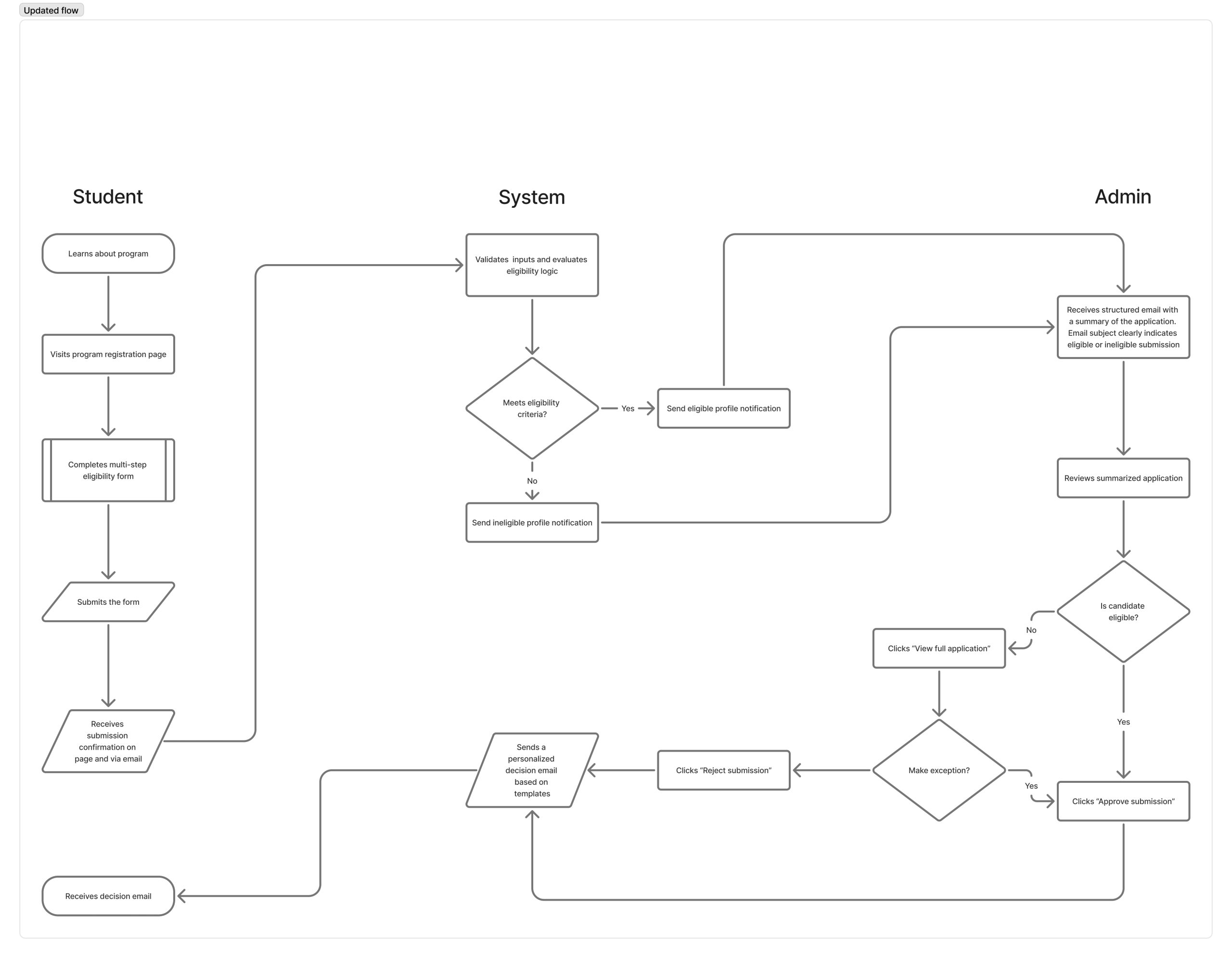
Student visits the website and lands on the registration page
Registration page includes program information and a multistep application form
Student completes the multistep form
Integrates eligibility criteria as structured logic, allowing eligibility to be evaluated programmatically upon submission
Reduces the number of steps in the application process and eliminates platform switching
Reduces cognitive load by grouping related information and breaking the form into manageable steps
Provides clear validation and error states at every step
Discourages spam and low-effort submissions without using CAPTCHAs
Allows students to move back and correct mistakes at any point
Uses progress indicators to show completion status and reduce abandonment
Upon submission, students see a clear confirmation screen stating that the application was successfully submitted
Students also receive an almost-instant receipt confirmation email reinforcing that their application has been received and will be reviewed
ADMIN WORKFLOW
Admin receives a notification email when a new application is submitted
The email subject clearly indicates whether the submission meets eligibility criteria or not
The email body contains a structured summary of the application responses, providing immediate context without exposing sensitive data
For eligible submissions, the email includes a secure “approve submission” link
For ineligible submissions, the email includes a “view application” link that takes the admin to the dashboard for full review
Admin can review the application details in the dashboard when needed
Admin can approve or reject the submission using simple, clearly defined actions
All actions require verification to prevent unauthorized access
Admin decisions trigger personalized, templated emails to students
Response timing is intentionally delayed to reinforce human review and avoid automated signaling
INTENTIONAL HUMAN-IN-THE-LOOP AUTOMATION
While full automation was possible, a human review step was intentionally preserved to:
Avoid impersonal, immediate rejections so that students feel their applications are fairly considered. This reduces trust erosion and emotional distress, since the applicants invest a significant amount of time and effort in their applications
Give admins control and allow discretionary exceptions for edge cases that the algorithm would otherwise exclude
Prevent students from submitting multiple applications in an attempt to “beat the system” once they realize the decisions are automated
Safeguards & Trust Decisions
No instant acceptance or rejection: Responses are intentionally delayed to avoid signaling automation and to reinforce trust in the fairness of the program.
Human review for all decisions: Admins have to review every application, especially those flagged as ineligible, before a final decision is made and communicated with the candidate.
Extra review step for rejections: Ineligible profiles require admins to view the full application in the dashboard before making a decision. Admins can use their discretion to make an exception for an ineligible candidate.
Limited data exposure in emails: Admin emails include a structured summary instead of full application data to protect applicant privacy.
Secure admin actions: Approval and review links require verification to prevent unauthorized access.
Multi-step form with validation: Reduces spam, prevents incomplete submissions, and improves data quality without using CAPTCHAs.
Clear confirmation and messaging: Students receive immediate confirmation that their application was submitted and will be reviewed. In case of errors, they get clear, unambiguous error messages pinpointing the exact issues that need to be fixed.
Centralized data with regular backups: Reduces risk of data loss while improving consistency and manageability.
Branding consistency across pages and emails: Reinforces legitimacy and trust, especially at the moment of submission.
Admin training and support: Ensures adoption, correct usage, and confidence in the new system.
Trade-Offs and Design Choices
Form length vs cognitive load: Multi-step was chosen over a single long page or a short “basic info + link to full eligibility form” approach. The long page was overwhelming for users, while the short form added an extra unnecessary step. The multi-step approach balanced cognitive load and workflow efficiency.
CAPTCHAs vs user experience: CAPTCHAs are effective for spam prevention, but prior feedback from other forms showed users found them frustrating. In this project, spam was managed through the multi-step form combined with validation and logic, avoiding CAPTCHAs entirely.
Response timing – speed vs trust: A minimum of two business days and a maximum of ten business days was chosen for responses. Instant acceptance or rejection would compromise human trust, while too much delay would frustrate applicants. This timing ensures automation for efficiency while preserving the perception of fair review.
Admin emails – convenience vs data privacy: Emails were structured to give admins an at-a-glance context of the submission and show eligibility based on predefined criteria. Quick-action links allowed one-click approval or rejection, with authentication added for security. Only a summary of the application (vs the full application – which would have been more convenient) was sent to protect applicant privacy.
Extra step for profile rejections – convenience vs risk: Eligible submissions can be approved with one click via the notification email. Ineligible profiles require admins to click “view application” and review the full application on the dashboard before making a decision. This accounts for the higher emotional and operational risk of rejections.
Eligibility logic – simplicity vs fidelity: Eligibility rules were simplified for implementation as if-else logic without compromising integrity. This required limiting free-form input while preserving the essence of the application criteria.
Results
FOR STUDENTS
Fewer steps, fewer redirects and clearer expectations: Application completion has now dropped from 45–60 minutes across multiple days–weeks, and multiple platforms to 7–15 minutes in one session on a single platform.
Reduced frustration and uncertainty: The number of “did you get my application” emails dropped from hundreds weekly to almost none as students receive immediate on-page and email confirmation.
Greater confidence in the legitimacy of the process and the organization: Students now feel more confident they are not at risk of scams, and they trust the organization more based on the streamlined, professional application experience.
Perceive fairness and professionalism, reinforcing trust: The subtle layer of automation allows the students to enjoy the faster application processing while maintaining trust in the organization’s fairness and human touch in reviewing their applications.
FOR ADMINS
The system was designed so admins could make fast, confident decisions without second-guessing data quality or system behavior
Dramatically reduced manual work and operational cost: A task that previously required a team of over 10 people now requires 2 people (with one person in the lead and the other in a supporting role).
Reduced backlog and faster application processing: Admins previously took days to weeks per application (scanning their emails for the submissions from the basic form, sending out the eligibility form, manually analysing the submission against admission criteria, writing an email to let the candidate know the outcome, etc). Now, this process takes 2-5minutes.
Lower risk of manual error: The added layer of automation minimizes mistakes, such as accidentally rejecting an eligible student or accepting an ineligible one. Student submissions no longer get lost in multi-step workflows because all steps are consolidated on one platform.
Reduced spam and abandonment: Submission volume exceeded 1,500 applications within three weeks of rolling out the update, compared to the fewer than 100 per week previously. Additionally, approximately 99% of submissions are legitimate, strong leads.
Centralized, organized data for better decision-making: Admins can now access all student data from a single dashboard, eliminating the need to consolidate mismatched and incomplete data from multiple platforms.
Consistent communication without copy/paste errors: Now that emails are generated from templates, it is easier to ensure consistent messaging while maintaining personalized communication. Managing email templates is also so much easier and straightforward.
FOR THE PROGRAM
Improved scalability: The new system makes it easier to handle more applications without overly increasing admin workload.
Lower operational risk: Centralized data, structured workflows, and automated checks reduce the likelihood of errors and lost applications.
Lower operational cost: With fewer admins and fewer tools required for the same workload, the program now operates more efficiently.
Enhanced data quality and insights: Centralized, organized data allows program managers to analyse trends, measure interest and make informed decisions more easily.
Stronger perception of professionalism and fairness: Applicants have a better perception of the program and trust they are being fairly evaluated. This reinforces brand reputation and applicant satisfaction.
WHAT CAME NEXT
This foundation enabled the creation of an admin dashboard for managing students, courses, and access to program content online. Accepted students received login credentials as part of their acceptance flow, extending the system beyond admissions into ongoing program management.
Metrics
|
Metric |
Before |
After |
Impact analysis |
|
Application completion time |
45–60 minutes across multiple days |
7–15 minutes in one session |
About 80% reduction: single-session completion reduces friction |
|
Weekly student follow-ups |
200+ emails |
<10 emails |
>95% reduction: immediate feedback about application submission improves trust |
|
Admin team size |
10–15 people |
1–2 people |
85–87% fewer staff needed, lowering operational cost |
|
Time per application |
Days–weeks |
2–5 minutes |
~95% faster, backlog considerably reduced |
|
Submission abandonment / spam |
High |
99% legitimate submissions |
Significant increase in lead quality, near-zero spam |
|
Data consolidation |
Multiple platforms, fragmented |
Centralized dashboard |
100% of data centralized, easier decision-making |
|
Weekly application volume |
<100 |
500+ |
5× increase in completed applications |
|
Perceived fairness & professionalism |
Moderate |
High |
Students trust process more, this reduces anxiety and complaints |
|
Operational cost & scalability |
High with limited scalability |
Lower cost, better scalability |
Enables program growth without increasing admin load |
Risks & Mitigations
|
Risk |
Details |
Mitigation |
|
Single system dependency |
Relying on one centralized form and database creates a potential single point of failure |
Daily backups, continuous monitoring and testing, immediate alerts to developers if the form or database fails. |
|
Data loss or compromise |
If the database is lost or breached, all submissions could be affected |
Properly secure the database, daily backups, strict access controls, and minimal sensitive information sent via email |
|
Admin adoption risk |
Admins may struggle to adapt to the new system or resist the changes, which will make the whole redesign mute |
Provide clear training, documentation, and a sandbox environment for practice before live rollout |
|
User abandonment or frustration |
Multi-step forms or validation errors could discourage students from completing applications. |
Include progress indicators, clear validation messages at each step, and the ability to go back and edit previous steps to reduce cognitive load |
|
Trust erosion through automation |
Fully automated rejections could feel impersonal and reduce confidence in the program |
Preserve a human review step, prescribe delaying responses by 2–10 business days, and allow admins to override the system in edge cases. |
Reflection
- This project reinforced an important principle: automation should reduce friction, not remove humanity. Trust is primordial for systems like this and humans must remain in decision loops for sensitive processes
- Simple, clear, and structured data makes scaling possible without increasing staff workload
- Iterative testing in sandbox environments uncovers subtle usability and technical issues
- Strategic use of multi-step design can greatly increase quality of submissions, and reduce abandonment
- By designing the system around both operational efficiency and emotional trust, the solution improved outcomes for students, administrators, and the organization without sacrificing empathy.
Future Improvements
- Add a final review summary step for students before submission
- Allow edits prior to final confirmation
- Enable save-and-continue functionality
- Support multiple programs with different eligibility rules
- Adjust response rules for increased submission volumes